
MONASTERY OF PANAGIA OF KORNOFOLIA
The Holy Monastery of Kornofolia or monastery of Panagia Portaitissa, as it is also known, is built at a distance of one kilometer west of the village of Kornofolia of Soufli, on the hill “Kouri” and is honored in the memory of the Assumption of the Virgin Mary.
The main feast of the Monastery is held at “Apodosis of Koimisis”, meaning nine days after the Assumption of Virgin Mary on 23 of August. It is unknown what the exact date of monastery’s construction is. The local tradition wants it to have a history of about four centuries.
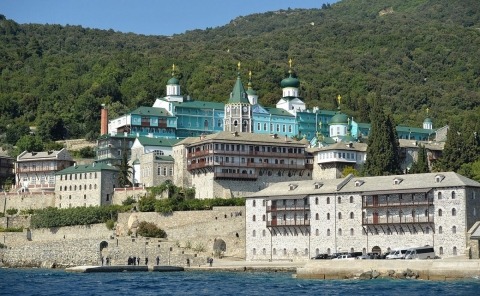
At the beginning of the 18th century it was given as a metochi (glebe land) to the Holy Monastery of Iveron on Mount Athos. In the year 1747, with the consent of the inhabitants of Kornofolia and with the actions of Metropolitan of Didymotichos Afxentios (May 1744 - July 1757) and the abbot of the Monastery, Hieromonk (Priestmonk) Afxentios, the ownership of the Monastery of Iveron was notarized and validated with a Patriarchal sigil (decision) of the Holy Synod of the Ecumenical Patriarchate of Constantinople, under Patriarch Paisios II.
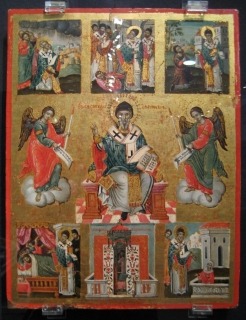
After its grant to the Monastery of Iveron, the Holy Fathers of Mount Athos brought to the metohi (glebe land) a copy of the holy icon of the Virgin Mary of Portaitissa which is in the Monastery of Iveron on Mount Athos, and proved to be equally miraculous with the original one, as well as the right leg of Saint Charalampus .
With these two Holy Relics and consecutively with the Monastery, the Hellenism of Kazas (Prefecture) of Andrianoupoli was closely connected. The Greek inhabitants of the area surrounded with great love, reverence and respect the Monastery and its two most precious holy relics. Here they hasted in every difficult moment of their enslaved life to ask firstly the grace and help of Virgin Mary and Saint Charalampus and secondly the advice and active support of the father confessors of the monastery.
So this monastery became quickly a great religious, spiritual and national center of the enslaved Hellenism of the region. A secret school was being operated in it and it also served as a gathering place for men in the area to be trained in the countryside and to form groups of rebels against the Turks. Its abbots were willing to help with this, and some of them became an example of sacrifice on the shrine of faith and homeland. Indicatively is mentioned the abbot Porphyrios, who died a torturous death by the Turks in 1912.
The Katholikon (catholic, major temple) of the Monastery is a three-aisled vaulted basilica with a single roof. Above the main entrance of the main temple, an inscription on a marble plaque indicates that the existing Katholikon was built in the place of an older one, which was in a bad condition and was inaugurated on August 15, 1857.
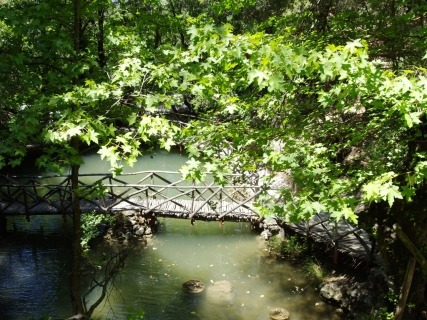
Nowadays, a feminine fraternity dwells in the monastery. The surrounding area of the monastery is beautifully landscaped.