
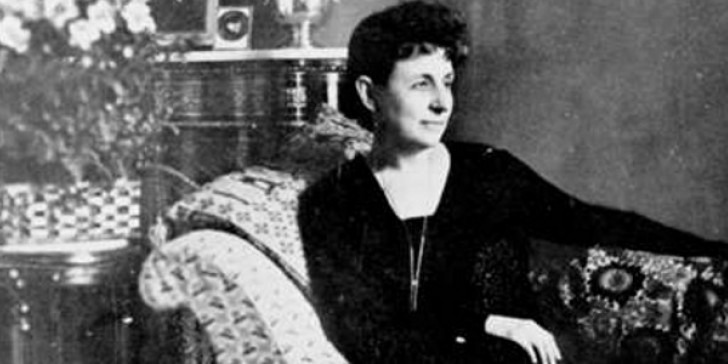
Penelope Delta
Penelope Delta was a writer. She wrote books for children and teenagers. Her books, which were loved by many generations, covered the gap that used to exist for many years in the literature for these ages. The Byzantine history, the Macedonian war and religious tradition inspired her, so her books radiated proud and love for Greece.
She was born in 1873 at Alexandria, Egypt. Her father was Emmanuel Benakis and her mother Virginia Choremi. Her upper-middle-class family gave her the best education and many travels to Greece and Europe. Her first appearance as a novelist took place in the Alexandrian magazine Esso Etimos.
She was raised in a very strict family environment so marriage out of love wasn’t a possibility. At 21 she married a cotton dealer, Stefanos Deltas, following her family’s wish. They had three daughters. In 1905 she met Iona Dragoumi in Alexandria. Their love was fierce and unfulfilled and lasted three years.
In 1908 her family moved to Frankfurt. There Penelope met Manolis Triantafilidis and other people that were supporters of demotic language, who played a determining role in the evolution of her writing skills. Her correspondence with Byzantinologist Gustave Schlumberger was a determining factor too, because he helped her to set up a very realistic and historically correct background for her books which were related to the Byzantine history.
In 1909 she published her first book For the Sake of the Fatherland. Other famous books followed Secrets of the Swamp, In the Heroic Age of Basil II: Emperor of Byzantium, A tale without a name.
Her interest for history led her to collect historic evidence, like oral narrations and memoirs of the Macedonian war soldiers –from these sources we can draw on a lot of important information. But she didn’t limit her work only to this but she took part in missions that helped hostages relocate in Macedonia as well as refugees of the Asia Minor Disaster of 1922.
In 1925 she discovered that she had polio and day by day her body paralyzed. After 16 years that disease had debilitated her she decided to end her life with poison when she found out that the Germans had invaded Athens.